
Rule of Thumb
If your garage door is hard to open on a cold morning, it's almost never actually frozen solid — it's usually just stiff. True ice only forms when rain or heavy dew sits under the door overnight and the temperature drops far enough to set it, which does happen in Highland during winter storm systems, especially on slabs that slope slightly or collect runoff near the threshold. Most of the time, though, what feels like "frozen" is cold metal, thickened grease, and a spring that's lost a little tension overnight — all fixable without a hammer and a prayer.
What You'll Notice
- The door won't budge, or the opener strains and clicks without lifting it.
- It opens partway, then stalls or reverses back down.
- A loud pop or bang right before it finally breaks free.
- One side lags behind the other, so the door travels crooked for the first few inches.
- Visible ice or a damp, stuck seam along the bottom weatherstrip where it meets the concrete.
Which symptom you get is a pretty good clue to which cause is at play — and it also mirrors the order a technician works through when diagnosing a cold-weather no-go.
1. Bottom Seal Frozen to the Slab
This is the first thing to rule out because it's the most obvious. After a rainy night followed by a cold snap, the rubber weatherstrip along the bottom of the door can bond to a thin layer of ice on the concrete. You'll usually see or feel dampness right at that seam. The fix here is simple: never force the opener. Pour warm (not boiling) water along the seal, or use a hair dryer on low heat, to break the bond, then dry the area. If this happens repeatedly, the long-term fix is a new weatherstrip with a better seal profile, or regrading a shallow puddle spot right at the threshold so water doesn't collect there in the first place.
2. Springs That Have Lost Tension in the Cold
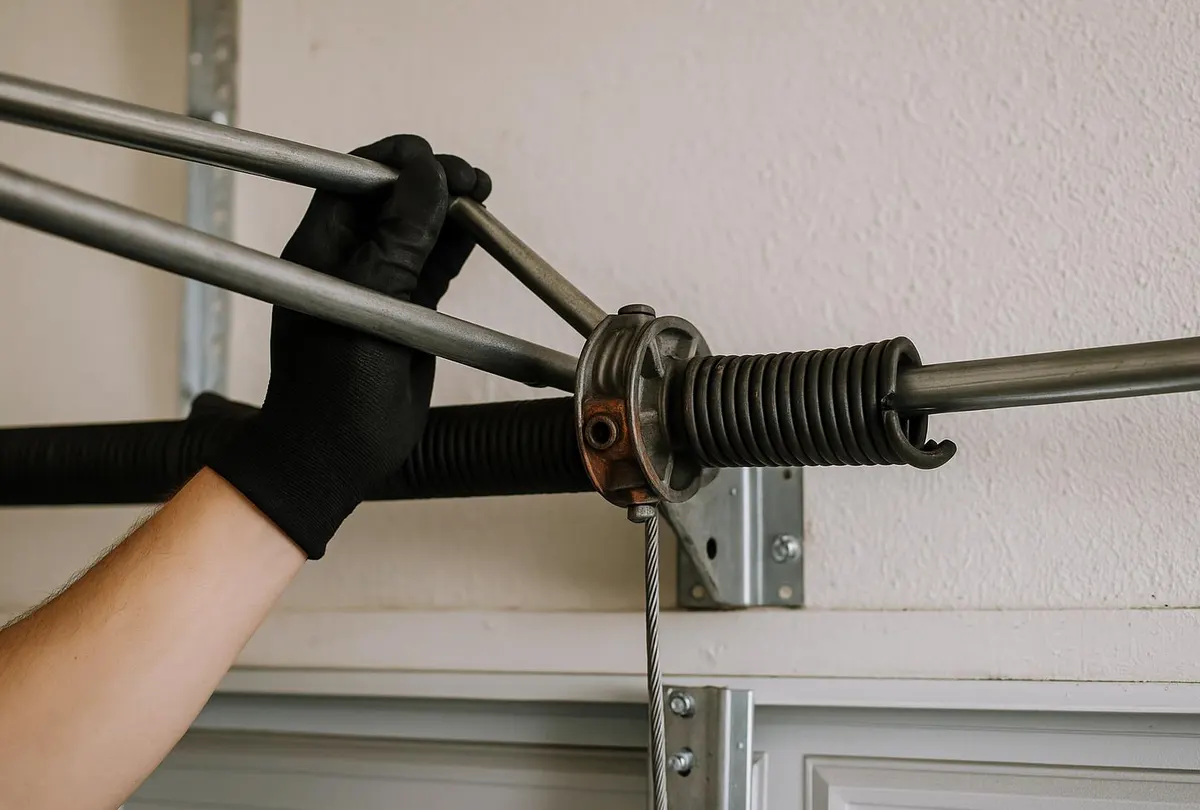
Metal contracts slightly as it cools, and torsion springs are no exception. A spring that's already a few years old and losing strength will feel noticeably weaker on a 35–40°F morning than it does in July. This shows up as an opener that strains, clicks, or stalls partway up — because the springs aren't doing their share of the lifting, and the motor is taking the full load of the door. A technician checks this by disconnecting the opener and lifting the door by hand: if it feels heavy or drops instead of staying put, the springs are undersized or near the end of their service life. The fix is spring replacement, matched to the door's weight and cycle count, not a tweak or a re-tension — stretched steel doesn't go back to factory spec.
3. Dried-Out or Gelled Lubricant
Cold thickens grease and grime on rollers, hinges, and the track itself, adding drag right when the springs are already working harder than usual. This usually shows as a door that's slow and a little jerky rather than fully stuck. The fix is a proper cleaning and re-lubrication of the rollers, hinges, and torsion bar with a garage-door-specific lithium or silicone lubricant — not household oil, which attracts dust and grit and gums up again fast, especially with the dry, dusty air that blows through Highland between storms.
4. Opener Force Settings Out of Adjustment
If the door opens partway and reverses, or the opener seems to give up, the force settings may be tuned for a lighter load than what the door presents on a cold day with stiff springs and thicker grease. A technician checks the up-force and down-force limits next, since adjusting these is quick — but it's a band-aid if the real problem is #2 or #3. Force settings should support the door, not compensate for a mechanical issue underneath.
5. Track and Cable Wear Showing Up Under Load
Cold contraction can make an existing issue — a slightly bent track, a frayed cable, a loose roller bracket — suddenly obvious, because there's less give in the system. This is usually the cause when one side of the door visibly lags or binds while the other moves freely. The fix ranges from track realignment to cable replacement, and it's worth catching early: a cable that snaps under tension is a safety issue, not just an inconvenience.
When to Call Highland Garage Door
If your door is sticking, straining, or moving unevenly as the weather turns, it's worth having it looked at before the first real cold snap sets in. Highland Garage Door handles both Spring Replacement and Garage Door Maintenance visits that cover lubrication, track alignment, and opener force checks in one trip — the same checklist a technician runs through for exactly the symptoms above. Catching a weak spring or a worn cable in November is a lot cheaper than dealing with a door that won't open at all in January.
If your garage door is giving you trouble this season, call Highland Garage Door — your local garage door company serving Highland, CA and the surrounding Inland Empire.