
What another season of "we'll deal with it later" actually costs
Here's the real math: a worn torsion spring that finally lets go doesn't just strand your car. It can crack a panel, bend a track, or send a cable snapping across the garage hard enough to hurt someone standing nearby. A fix that costs a few hundred dollars now turns into a full door replacement plus a repair bill if it fails while someone's underneath it loading groceries. Winter rain is coming, which means more days with the door cycling while you're carrying things in and out, more humidity working on old hardware, and less patience for a door that sticks halfway up. Putting this off isn't neutral — it's betting that nothing breaks before spring.
Why a 1990s-or-older door isn't just "older," it's a different kind of machine
Garage doors built decades ago were engineered to a lower safety standard than what's sold today. Many older openers have no photo-eye sensors at all, meaning the door will keep closing even if a kid, pet, or bike is in the path. Some still use a single torsion spring instead of a two-spring or cable-backed system, so when that one spring fails, there's nothing holding the door's weight. None of this means the door is junk — it means certain parts of the system carry real risk and others are just cosmetic.
Retrofit these: the non-negotiables
- Photo-eye sensors. If your opener closes the door without stopping when something breaks the beam near the floor, that's not a quirky old feature — it's a hazard, especially with kids or pets in the house. This is a straightforward upgrade.
- Auto-reverse function. Test it: lay a 2x4 flat where the door closes. If the door doesn't reverse on contact, the opener needs to be repaired or replaced before it's used again.
- Spring safety cables. These run through the center of torsion springs and keep a broken spring from flying across the garage. If your system doesn't have them, that's a cheap add that prevents a genuinely dangerous failure.
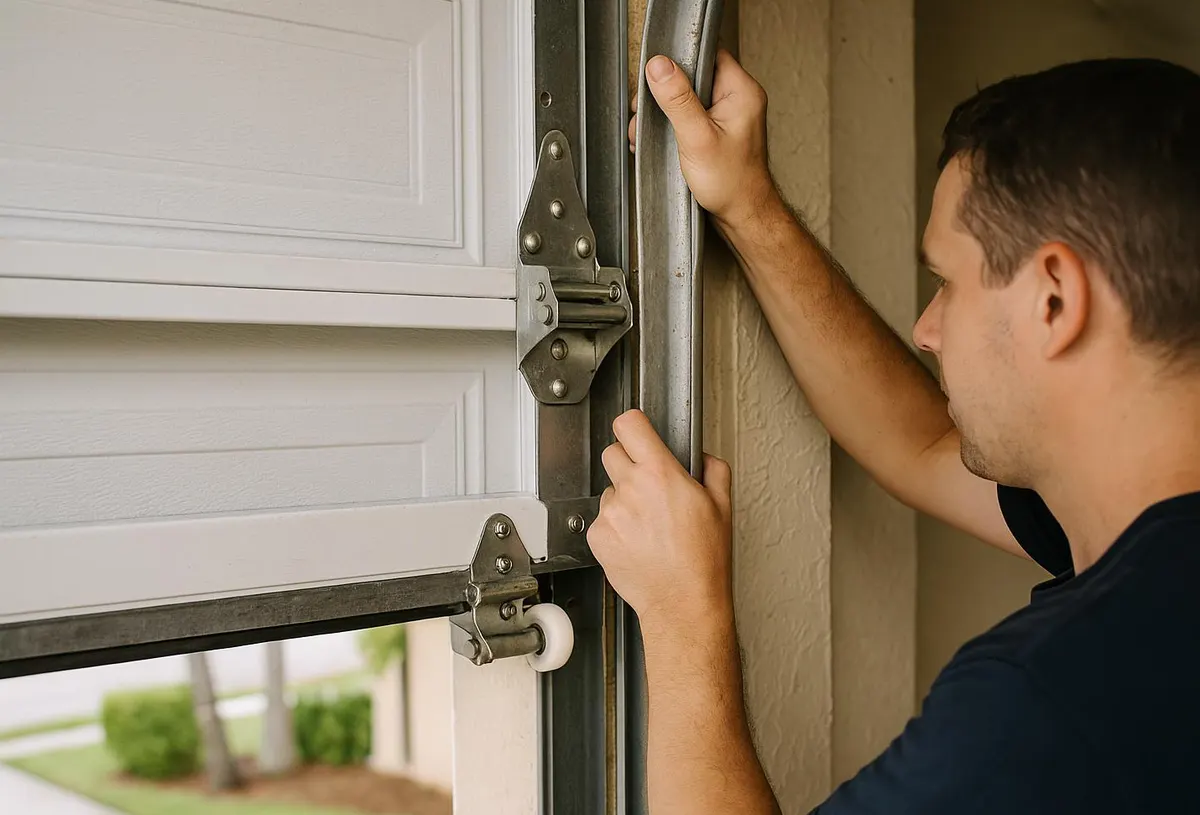
- Rusted or frayed cables and worn rollers. Inland heat cycles and dust mean metal parts dry out and corrode faster than people expect. If cables are fraying or rollers are chipped, replace them before they fail mid-cycle.
- Manual release and emergency disconnect. On an older opener, confirm the red release cord still works smoothly. In a power outage or earthquake aftermath, this is how you get the door open by hand.
Leave these alone (for now)
- Original wood or steel panels in good shape. If they're not warped, rusted through, or cracked, there's no safety reason to replace them. Cosmetic wear isn't a hazard.
- A quiet, reliable motor. If the opener motor itself still runs smoothly and isn't straining, grinding, or overheating, you can often add modern safety sensors to it rather than replacing the whole unit.
- Straight, unbent tracks. Old doesn't mean broken. If the tracks are aligned and the door glides without catching, there's nothing to fix.
- Original weatherstripping that's still sealing well. Check it before assuming it needs replacing — if it's not cracked or letting in daylight, it's doing its job through the rainy season.
Where the two arguments usually collide
One spouse wants to replace the whole door because it's old; the other doesn't want to spend money on something that still opens and closes fine. The honest answer is usually in the middle: a full door replacement makes sense when the panels are damaged, the door is poorly insulated for inland summer heat, or an earthquake retrofit calls for reinforced bracing anyway. But if the structure is sound, targeted upgrades to the sensors, springs, and cables solve the actual safety problem for a fraction of the cost — and that's the argument-ending version most households land on.
When to call Highland Garage Door
If your opener has no photo-eye sensors, the auto-reverse test fails, or you're not sure whether your spring system has safety cables, that's worth a visit rather than a guess. Highland Garage Door handles Spring Replacement and Garage Door Opener Repair & Installation, and can tell you on the spot whether your 1990s-era system needs a few targeted safety upgrades or a full opener swap. A Garage Door Maintenance visit before the rainy season sets in is also a low-cost way to catch rust, worn rollers, or cable wear before they turn into an after-hours call.
If you're in Highland, San Bernardino, Redlands, Loma Linda, Yucaipa, Colton, Rialto, or Grand Terrace and you've got a garage door system older than your car, call Highland Garage Door for a straight answer on what needs fixing and what can wait.